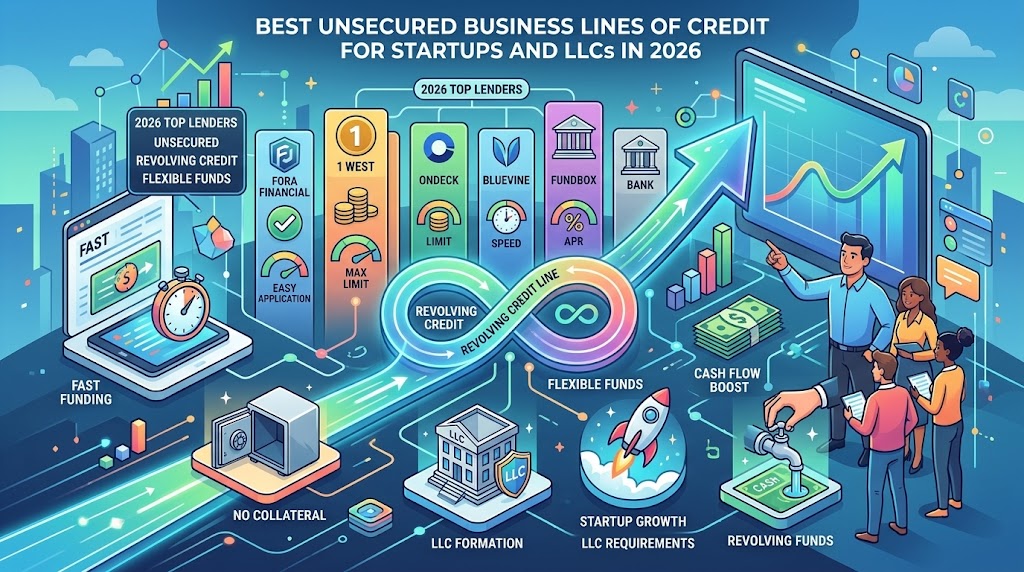
Best Unsecured Business Lines of Credit for Startups and LLCs in 2026
📖 Table of Contents
- 2026 Provider Matrix: Top Institutional & Fintech Credit Lines
- Anatomy of an Unsecured Facility: Mechanics, Fees, and Liens
- Commercial Underwriting Standards: How Lenders Screen LLCs
- SBA Working Capital Line Requirements vs. Private Credit
- Step-by-Step Documentation & Application Checklist
- Optimizing Capital Velocity: Draw Strategies for High-Growth Startups
Securing non-dilutive working capital without encumbering critical enterprise assets is one of the most significant balance sheet hurdles for emerging enterprises. For founders navigating volatile supply chains, fluctuating payroll cycles, or inventory expansion, an unsecured business line of credit provides an agile financial cushion. Unlike conventional term debt, a revolving credit facility allows businesses to draw funds up to a predetermined limit, service interest solely on the active balance, and replenish capital as revenues materialize.
In 2026, the credit environment presents both unprecedented efficiency and stringent risk-pricing models. Commercial banks and venture lenders have increasingly turned to programmatic, API-driven underwriting. While this transition accelerates fintech business credit approval timelines—often compressing decisions into hours rather than weeks—it also demands operational discipline from LLC managing partners and startup founders. Lenders have tightened real-time cash flow monitoring and adjusted variable annual percentage rates (APRs) to counter macroeconomic fluctuations.
This authoritative guide dissects the top institutional and alternative credit lines available in 2026. Below, you will find an empirical comparison matrix of premier market providers, an analysis of commercial underwriting benchmarks, a documentation checklist for enterprise readiness, and strategic frameworks designed to help you capture competitive rates without pledging business assets.
2026 Provider Matrix: Top Institutional & Fintech Credit Lines
To streamline your capital acquisition process, the following comparison table details the top five unsecured revolving credit facilities accessible to startups and operating LLCs in 2026. These platforms balance speed, cost of capital, and collateral independence.
| Lender / Platform | Facility Type | Credit Score Min. | Typical APR Range | Draw / Origination Fees | Maximum Line Size | Approval Speed |
| :— | :— | :— | :— | :— | :— | :— |
| Bluevine | Fintech Revolving Line | 625 FICO | 14.5% – 28.9% (Simple Interest/APR) | 0% Draw Fee | Up to $250,000 | Under 24 Hours |
| American Express Business Blueprint | Institutional / Direct | 660 FICO | 12.0% – 26.0% (Term-adjusted rate) | 0% Origination | Up to $250,000 | Same Day to 48 Hrs |
| Fundbox | Automated Cash-Flow | 600 FICO | 16.5% – 28.0% (Equiv. APR) | Flat fee per draw (4.66%+) | Up to $150,000 | Minutes (Algorithmic) |
| Chase Business Line of Credit | Commercial Bank | 680 FICO | Prime + 2.75% to 7.99% (~11.25% – 16.5%) | $150 Annual Fee | Up to $500,000 | 3 to 7 Business Days |
| Headway Capital | Alternative Line | 580 FICO | 18.0% – 28.5% | 2% – 5% per draw | Up to $100,000 | 1 Business Day |
Provider Insights and Operational Viability
- Bluevine: Tailored for business-to-business (B2B) LLCs exhibiting steady monthly invoicing. Integration with modern accounting engines (QuickBooks Online, Xero) enables rapid underwriting based on operational cash velocity rather than static historical tax records.
- American Express Business Blueprint: Provides premier terms for mid-tier startups with strong personal credit foundations. The elimination of prepayment penalties and draw fees makes this one of the most capital-efficient revolving credit lines for small business.
- Fundbox: Leverages pure micro-transaction data. While fee structures are calculated on a flat 12-week or 24-week repayment matrix, the effective APR sits between 16% and 28%, making it best suited for temporary working capital deficits rather than long-term leverage.
- JPMorgan Chase: The institutional gold standard for businesses with over 12 months of operational seasoning. It requires deeper documentation, but provides lower carrying costs via standardized benchmark spreads.
- Headway Capital: Built for early-stage enterprises or LLCs operating with suboptimal credit profiles. Its higher draw fees balance the lender’s exposure to structural underwriting risk.
Anatomy of an Unsecured Facility: Mechanics, Fees, and Liens
The defining parameter of an unsecured business line of credit is the absence of specific pledged collateral, such as commercial real estate, titled fleet vehicles, or designated machinery. However, corporate officers must not confuse ‘unsecured’ with ‘risk-free’ or ‘liability-free.’
UCC-1 Blanket Liens vs. Specific Asset Pledges
While a lender issuing no collateral business loans does not attach an interest to a specific machine or land parcel, institutional guidelines dictate that almost all unsecured business lines retain a UCC-1 Blanket Lien on the enterprise.
According to standard commercial underwriting regulations:
“An unsecured commercial facility waives specific asset perfection but typically enforces a general security interest over all unencumbered corporate personal property to protect the creditor in the event of involuntary liquidation or restructuring.”
This means that if your LLC defaults, the lender holds a general, senior claim against your enterprise’s remaining liquid assets, accounts receivable, and unliquidated inventory, trailing only behind purchase-money security interests (PMSI) or senior bank facilities.
The Role of the Personal Guarantee (PG)
For newly formed LLCs and early-stage startups lacking a multi-year audit history, true non-recourse credit lines are virtually non-existent in private lending. Lenders require an unlimited or limited Personal Guarantee from every equity partner holding a 20% or greater interest.
Under an unlimited PG, the individual guarantor’s personal estate—liquid accounts, home equity, and private assets—remains fully attachable should the corporate entity fail to satisfy draw down obligations. LLC managing partners must rigorously calculate their debt-service coverage ratio before leveraging facilities backed by personal recourse.
The Hidden Costs: Draw Fees, Maintenance, and Prepayment Charges
When comparing total cost of capital, looking solely at the headline APR leads to distorted balance-sheet projections. Corporate treasurers must factor in secondary cost layers:
- Draw Fees: Certain fintech lenders charge between 1.5% and 5% simply to disburse funds from the credit vault into your operating account. If you draw $50,000 at a 3% draw fee, you immediately surrender $1,500 before the capital executes a single transaction.
- Inactivity Fees: Institutional accounts may penalize businesses that maintain a zero balance for over six consecutive months, levying annual charges ranging from $150 to $500.
- Factor Rates vs. Simple Interest: Several alternative providers quote rates via factor models (e.g., 1.15x) rather than standard declining-balance APRs. This fundamentally increases the real interest paid because the repayment schedule does not reduce the base interest liability as principal is returned.
Commercial Underwriting Standards: How Lenders Screen LLCs
Commercial credit underwriting in 2026 has bifurcated into two dominant methodologies: algorithmic data synthesis (fintech) and balance sheet ratio scrutiny (commercial banking).
[Applicant Bank / Accounting APIs]

          │

          ▼

[Direct API Ingestion (Plaid / Codat)] ──► Checks Average Daily Balance (ADB)

          │                             ──► Measures NSF / Overdraft Frequency

          │                             ──► Verifies Debt Service Coverage (DSCR ≥ 1.25x)

          ▼

[Credit Bureau Aggregators] ───────────► FICO SBSS Score & Personal Bureau Hard Pull

          │

          ▼

[Automated Risk Engine] ───────────────► Instant Offer Generation ($10k - $250k)
Algorithmic Cash-Flow Underwriting
Contemporary alternative lenders minimize manual human review by establishing programmatic connections to your commercial operating accounts via services like Plaid or Codat. The core variables scanned include:
- Average Daily Balance (ADB): Lenders prefer a sustained minimum ADB equal to or greater than 10% to 15% of the requested credit line limit. Frequent drops below $2,500 trigger automated risk flags.
- Deposit Volatility and Velocity: Consistent, recurring deposits from diversified customer accounts receive priority over lumpy, single-source wire transfers. High revenue concentration (where a single client represents >40% of inflows) will diminish line approval values.
- Non-Sufficient Funds (NSF) Signals: Experiencing more than one NSF or negative balance event in a rolling 90-day window causes automatic programmatic rejection across roughly 85% of fintech credit platforms.
The Institutional Score: FICO SBSS Requirements
When dealing with traditional commercial banking partners like Chase, Wells Fargo, or regional banks, underwriting departments lean heavily on the FICO Small Business Scoring Service (SBSS) model. The SBSS aggregates:
- The primary applicant’s personal credit profiles (Experian, TransUnion, Equifax).
- Commercial bureau payment histories (Dun & Bradstreet Paydex score, Experian Business).
- Financial ratios derived from corporate tax filings and income statements.
SBSS scores scale from 0 to 300. While the federal benchmark for preliminary screening historically sits at 140, institutional approval for an uncollateralized line above $100,000 typically demands a baseline SBSS rating of 165 or higher in the current lending environment.
SBA Working Capital Line Requirements vs. Private Credit
Startups requiring higher limits ($250,000 to $1,000,000+) at baseline costs of capital must assess Small Business Administration (SBA) guaranteed products. The Small Business Administration provides frameworks specifically designed for revolving operational needs, most notably through modernized Working Capital Pilot initiatives and traditional CAPLines.
Navigating SBA Working Capital Line Requirements
Unlike rapid-approval fintech alternatives, obtaining an SBA-backed working capital facility is rigorous. Underwriters execute extensive reviews designed to satisfy Federal Credit Reform Act mandates:
- Time in Business: Typically requires a documented 24-month operating track record. However, exceptions exist for high-growth tech firms demonstrating committed institutional equity backing or clear contract guarantees.
- Debt Service Coverage Ratio (DSCR): The business must demonstrate an operating DSCR of at least 1.25x based on audited historical net operating income (NOI) divided by total annual debt obligations.
- Equity Injection & Net Worth: Startups must illustrate adequate equity capitalization. A debt-to-equity ratio exceeding 4:1 prior to facility disbursement often requires capitalization adjustments or owner note subordination.
- Comprehensive Hazard and Key-Person Insurance: Mandatory documentation ensuring uninterrupted operational continuity should corporate founders experience incapacity.
Strategic Trade-Off: Capital Cost vs. Execution Speed
- The Private Alternative: 24-hour liquidity injection, minimal upfront legal friction, flexible qualifying hurdles, but higher cost of capital (14%–28% APR).
- The SBA Vehicle: Low rate ceiling (typically pegged directly to Prime + 1.5% to 3.75%), large capital authorizations, but arduous closing phases spanning 30 to 90 days and complete asset transparency.
Step-by-Step Documentation & Application Checklist
To maximize approval odds and prevent underwriting suspensions, prepare this verified document vault before initiating an application for an unsecured business line of credit:
1. Corporate Identity & Structural Documentation
- [ ] Certified Articles of Organization or Certificate of Incorporation (verifying good standing with the Secretary of State).
- [ ] Operating Agreement (LLCs) or Corporate Bylaws with explicit borrowing resolutions empowering the signing officer.
- [ ] Employer Identification Number (EIN) Confirmation Letter from the IRS (Form CP-575 or 147C).
- [ ] Government-issued identification for all stakeholders holding equal to or greater than 20% equity.
2. Banking Verification and API Integration
- [ ] 6 to 12 months of consecutive, uncensored commercial bank statements (PDF format containing routing/account verification).
- [ ] Administrative credentials for banking API pairing via Plaid/MX to confirm real-time ledger health.
- [ ] Proof of dedicated business location (commercial lease, utility receipt, or modern co-working membership agreement).
3. Financial Statements and Tax Filings
- [ ] Year-to-Date (YTD) Balance Sheet and Income Statement (P&L) finalized within the past 30 days.
- [ ] 2 Years of Corporate Tax Returns (Forms 1120, 1120-S, or 1065). Startups under 2 years must present trailing-twelve-month (TTM) management-prepared financials.
- [ ] Complete business debt schedule accounting for all active merchant cash advances (MCAs), equipment finance contracts, and institutional obligations.
- [ ] Accounts Receivable (A/R) and Accounts Payable (A/P) Aging Reports categorized into 30, 60, and 90+ day intervals.
Optimizing Capital Velocity: Draw Strategies for High-Growth Startups
Acquiring an unsecured line is merely the first step; utilizing it efficiently without burning operating margins is what separates seasoned operators from distressed enterprises. High-growth LLCs should deploy the following capital preservation principles:
The Arbitrage of Short-Cycle Cash Conversions
Deploy your line exclusively for operations that generate clear return-on-capital velocity within the facility’s free or low-interest window.
Example: An e-commerce LLC purchases inventory at a 15% wholesale discount for bulk prepayment. If the company uses an unsecured line at an annualized APR of 18%, and sells out the inventory stock within 45 days, the actual carrying cost of the credit draw for those 45 days is only approximately 2.22% ($18% times frac{45}{365}$). The resulting net margin gained via the bulk supplier discount significantly outpaces the financing cost.
Preventing the ‘Perpetual Draw’ Trap
Underwriters closely monitor your balance paydown history. Maintaining a permanent utilization rate of 95% to 100% on a revolving line will trigger automated risk adjustments, potentially resulting in unilateral line cuts or an unexpected conversion into an amortized, closed-end term loan.
[Capital Draw: $50,000] ──► [Deploy into Inventory / Invoicing]

                                     │

                                     ▼

[Replenish Facility to $0] ◄─── [Collect Client AR within 45 Days]

        │

        ▼

[Preserves Credit Profile & Precludes High Variable Interest Burden]
Commit to a policy where every drawdown has an identifiable liquidating event attached. Pay down the drawn balance entirely every 60 to 90 days. This practice builds positive proprietary credit scoring within the lender’s algorithmic engine, earning your business unsolicited line increases and discounted draw-fee waivers over time.
សេចក្ដីសន្និដ្ឋាន (Conclusion)
Securing an unsecured business line of credit in 2026 is an accessible and scalable way to fuel working capital, provided enterprise operators navigate the lending ecosystem with structural preparation and clear operational data. Startups and emerging LLCs should not be discouraged by standard underwriting barriers; instead, leverage real-time cash flow verification through modern fintech options like Bluevine and American Express to build institutional confidence before graduating to larger commercial facilities.
Treat your credit facility as an active liquidity reserve rather than permanent debt. By maintaining clean corporate records, managing daily cash buffers, and adhering to strict drawdown schedules, you can insulate your business against market contractions while preserving ownership equity.