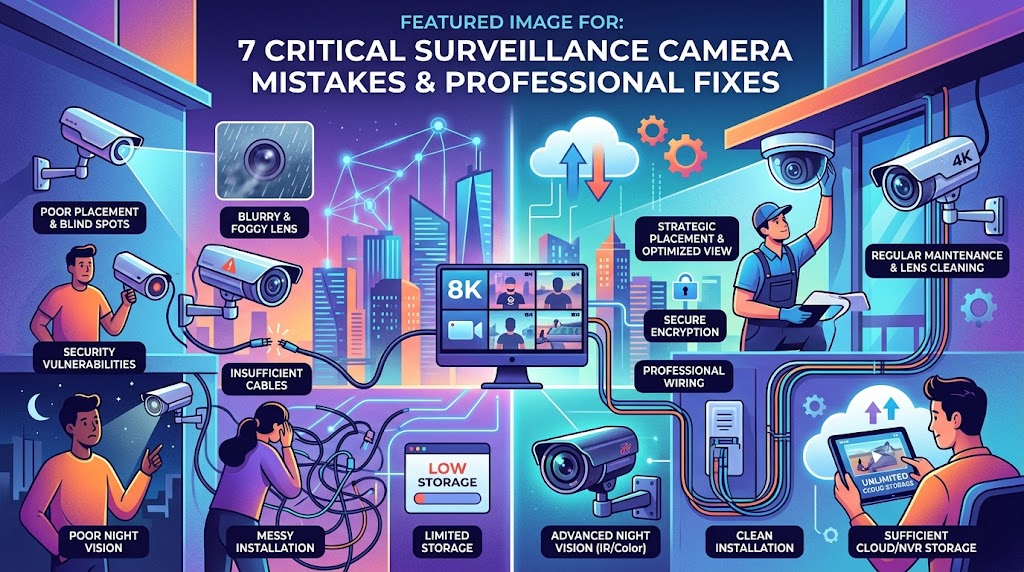
The Hidden Surveillance Trap: 7 Critical Mistakes in Neighborhood Security Mapping and How to Fix Them
📖 Table of Contents
- The Illusion of Security: Why Most Systems Fail
- Mistake 1: The High-Angle Fallacy and Blind Spot Creation
- Mistake 2: Violating Privacy and Legal Boundaries
- Mistake 3: Overlooking Hardware and Sensor Limitations
- Mistake 4: The Cybersecurity ‘Open Door’ Policy
- Mistake 5: Poor Storage and Data Management Strategies
- Mistake 6: The ‘Cry Wolf’ Effect: Alert Fatigue
- Mistake 7: Neglecting Physical and Software Maintenance
- Comparative Analysis: Storage Solutions
In an era where digital and physical security are increasingly intertwined, many homeowners and professionals approach surveillance with a false sense of complacency. You might think that hanging a single camera by your front door makes you ‘secure.’ However, the reality of modern residential monitoring is far more complex and pervasive than most realize.
When one begins to truly observe the landscape of modern living, the sheer density of monitoring devices becomes apparent. It is a sobering realization. In fact, I went looking for surveillance cameras in my neighbourhood: I found so many more than I thought, and this revelation highlights a massive gap between having cameras and having a functional security ecosystem.
Most people fall into common, avoidable traps that render their expensive hardware useless during a critical incident. In this comprehensive guide, we will dissect the seven most critical mistakes made in surveillance deployment—ranging from technical blind spots to legal liabilities—and provide professional-grade strategies to fix them. Whether you are an investor protecting property or a professional securing your home, these insights are essential for true peace of mind.
The Illusion of Security: Why Most Systems Fail
The fundamental error in most residential and small-business security setups is the assumption that coverage equals protection. People often buy the most expensive camera they can find, mount it, and assume the job is done. This mindset creates a ‘security theater’—a setup that looks impressive but fails precisely when it is needed most.
True surveillance is an integrated discipline. It requires understanding field-of-view (FOV), light physics, network integrity, and human psychology. To move from a hobbyist setup to a professional-grade system, you must move beyond ‘looking’ and start ‘monitoring’ with intent.
Mistake 1: The High-Angle Fallacy and Blind Spot Creation
The Problem: Looking at Foreheads, Not Faces
Many installers make the mistake of mounting cameras too high on a wall or under a deep eave. While this protects the camera from tampering, it creates a fatal flaw: you only capture the tops of people’s heads. In a forensic investigation, a top-down view of a hat or hair is far less valuable than a facial identification shot.
The Blind Spot Void
Furthermore, high mounting often creates significant ‘blind zones’ directly beneath the camera. A sophisticated intruder will identify these dead zones and use them to approach the property undetected.
[Image Placeholder: A diagram showing a camera mounted too high with a large dark area directly beneath it. Alt Text: Diagram illustrating common camera blind spots in residential security setups due to improper mounting height.]
How to Fix It
- The 12-Foot Rule: For facial identification, aim for mounting heights between 8 and 12 feet. This allows for a downward angle that captures features without being easily reachable by a person on a ladder.
- Overlapping Fields of View: Never rely on a single camera for a perimeter. Ensure that Camera A’s field of view covers the ‘blind spot’ of Camera B. This creates a seamless web of coverage.
Mistake 2: Violating Privacy and Legal Boundaries
The Problem: The Voyeurism Trap
In the rush to secure one’s own perimeter, many owners inadvertently record public sidewalks, neighbors’ windows, or backyard patios. This isn’t just an ethical lapse; in many jurisdictions, it is a legal liability. If your camera captures sensitive activities in a neighbor’s private space, you could face civil lawsuits or even criminal charges for invasion of privacy.
How to Fix It
- Privacy Masking: Modern professional cameras (IP cameras) offer a feature called ‘Privacy Masking.’ This allows you to draw digital black boxes over specific areas in the camera’s field of view (like a neighbor’s window) so they are never recorded.
- Angle Optimization: Instead of a wide-angle lens that captures the entire street, use a narrower lens focused specifically on your property boundaries. This minimizes the amount of ‘non-essential’ data collected.
Mistake 3: Overlooking Hardware and Sensor Limitations
The Problem: The Resolution Myth
Many consumers believe that ‘4K’ is the only metric that matters. However, a 4K camera with a tiny sensor and poor dynamic range will perform significantly worse at night than a 1080p camera with a large, high-quality sensor.
The Low-Light Failure
Most security incidents occur in low-light conditions. If your camera lacks high-quality Infrared (IR) LEDs or advanced ‘StarLight’ technology, your footage will be a grainy, unusable mess of digital noise when it matters most.
How to Fix It
- Prioritize WDR (Wide Dynamic Range): Ensure your cameras have excellent WDR. This allows the camera to balance extremely bright areas (like a sunlit driveway) with dark shadows, preventing the ‘blown-out’ look.
- [Image Placeholder: A side-by-side comparison of a low-quality night vision image vs. a high-quality infrared image. Alt Text: Comparison of poor low-light camera footage versus high-quality night vision security footage.]
- Invest in Sensor Size: When comparing specs, look at the sensor size (e.g., 1/2.8″ vs 1/3″). Larger sensors capture more light, resulting in clearer images in the dark.
Mistake 4: The Cybersecurity ‘Open Door’ Policy
The Problem: The Unsecured Gateway
Smart cameras are essentially small computers connected to your network. If they are poorly configured, they become the perfect entry point for hackers to access your entire home network, including personal laptops and banking information.
Common Vulnerabilities
- Default Credentials: Using the ‘admin/admin’ login that comes with the factory settings.
- Unencrypted Streams: Using older protocols that allow video data to be intercepted in transit.
How to Fix It
- Network Segmentation: Use your router to create a ‘Guest Network’ or a dedicated VLAN (Virtual Local Area Network) specifically for your IoT and security devices. This keeps them isolated from your main computers.
- Enable 2FA: Always use Two-Factor Authentication on the manufacturer’s cloud account.
- Regular Firmware Updates: Treat your cameras like your phone; if there is a security patch available, install it immediately.
Mistake 5: Poor Storage and Data Management Strategies
The Problem: The ‘Looping’ Nightmare
There is nothing more frustrating than reviewing a crime incident only to find that the footage was overwritten 10 minutes earlier because your storage was full. Many users rely solely on SD cards within the camera, which are easily stolen or corrupted.
How to Fix It
- The Hybrid Approach: Use a combination of local storage (NVR – Network Video Recorder) and cloud storage. The NVR provides high-capacity, high-bitrate recording, while the cloud provides a remote backup in case the physical NVR is stolen.
- Calculate Your Bitrate: Don’t just guess how much storage you need. Use a bitrate calculator to ensure your hard drives can handle the continuous stream of high-resolution data without dropping frames.
Mistake 6: The ‘Cry Wolf’ Effect: Alert Fatigue
The Problem: Notification Overload
Modern AI-driven cameras promise to detect ‘people, vehicles, and animals.’ However, poorly tuned settings lead to your phone buzzing every time a tree moves in the wind or a stray cat wanders by. This leads to ‘alert fatigue,’ where the user eventually mutes all notifications, effectively disabling the security system.
How to Fix It
- Zone-Based Detection: Don’t set the entire field of view to trigger alerts. Draw specific ‘Activity Zones’ that only include high-risk areas like doorways or driveway entrances.
- Sensitivity Tuning: Spend time calibrating the sensitivity of the AI. It is better to miss a minor movement than to be bombarded by 100 false positives a day.
Mistake 7: Neglecting Physical and Software Maintenance
The Problem: Set It and Forget It
Security cameras are exposed to the elements. Spider webs, dust, bird droppings, and even minor oxidation can significantly degrade image quality over time. Similarly, software becomes outdated, leaving you vulnerable to new exploits.
How to Fix It
- The Quarterly Audit: Every three months, physically inspect your cameras. Clean the lenses with a microfiber cloth and ensure the mounts are still tight.
- Software Health Check: Check the status of your hard drives and ensure the firmware is up to date. A camera that hasn’t been updated in two years is a security liability.
Comparative Analysis: Storage Solutions
Choosing the right storage architecture is vital for long-term reliability. Use the table below to guide your decision.
| Feature | SD Card (On-Camera) | NVR (Local Hard Drive) | Cloud Storage |
| :— | :— | :— | :— |
| Reliability | Low (Easy to steal/fail) | High (Robust/Redundant) | Very High (Off-site) |
| Video Quality | Compressed/Lower | Uncompressed/High | Variable (Based on Bandwidth) |
| Cost | Very Low | Moderate (Initial Investment) | Monthly Subscription |
| Access | Local Only | Local & Remote | Remote Only |
| Best For | Temporary/Low-budget | Professional/Full-time | Backup/Convenience |
Conclusion
Building a robust surveillance system is not about buying the most cameras; it is about buying the right cameras and deploying them with technical precision. By avoiding the common pitfalls of improper mounting, privacy violations, and cybersecurity neglect, you transform a collection of gadgets into a professional security asset. Remember, the goal is not just to record an event, but to provide actionable, high-quality evidence that protects your interests and your peace of mind. Audit your current setup against these seven mistakes today.